
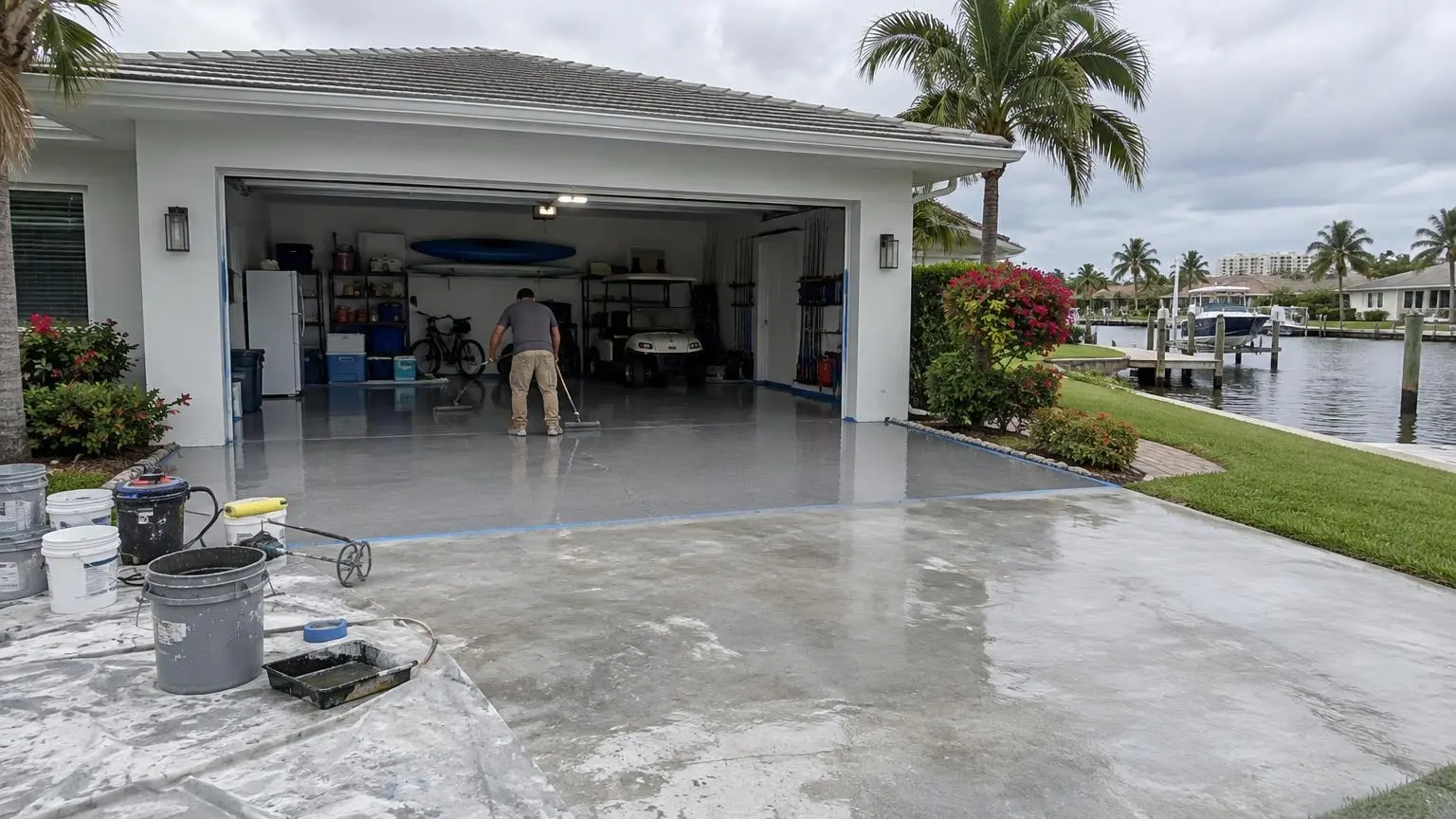
Polyaspartic floor coating
Polyaspartic Floor Systems in Fort Lauderdale, FL
A coating that handles hard sun and gives your garage back in about a day instead of most of a week.
- Free estimates at your home, where we measure and inspect the concrete in person
- Moisture testing on the concrete before any coating is chosen
- Every quote is written and itemizes the surface prep and each coat before giving the total price
When Polyaspartic Is the Smarter Choice
Polyaspartic floor systems are the coating we reach for in Fort Lauderdale when sunlight, speed or both are high on the list. Chemically, polyaspartic belongs to the aliphatic polyurea family. What that means on your floor is a film that holds up to UV, sets fast and stays flexible enough to handle the heat swings a garage or lanai goes through. It can be used as a full system, from primer to clear coat, or layered on top of an epoxy base coat.
Polyaspartic versus epoxy
HomeGuide's polyaspartic floor coating guide lays out the main differences. Polyaspartic has excellent UV resistance, while epoxy's is poor to fair. A polyaspartic floor is fully cured in roughly one to two days, and takes heavy vehicle traffic after 24 to 48 hours, while an epoxy floor can need up to a week. Each polyaspartic coat is thinner, around 2 to 6 mils, compared with 10 to 20 mils for an epoxy coat. That is why many systems use more than one polyaspartic coat, or pair a thicker epoxy base with a polyaspartic top. Lifespan in HomeGuide's guide is 10 to 20 or more years when the floor is properly installed.
Why the sun matters so much here
Fort Lauderdale averages around 3,000 hours of sunshine a year. When a garage faces west and the door stays up all afternoon, or a lanai is only partly roofed, plain epoxy starts to yellow and chalk. A polyaspartic surface holds its color, which matters most on light gray and white floors and on clear coats over flake. For outdoor slabs, we treat a UV-stable system as standard, not as an upgrade.
Fast cure is a real benefit, with a catch
Getting your garage back the next day is a big deal for most households, and for businesses that cannot close for a week. Per Bob Vila, people can usually walk on polyaspartic after 3 to 4 hours, and cars can come back after roughly 24. The same speed means the material has a short working time once it is mixed. That leaves little room for error, and it is a big part of why polyaspartic is not a DIY product. It has to be mixed in the right amounts, spread evenly and back-rolled before it starts to set, often in a fraction of the time epoxy allows.
Humidity and dew point during installation
Polyaspartic is more tolerant of cool temperatures than epoxy, but humid air still affects how it lays down and cures. In our wet season, from May through October, the air can be heavy enough that moisture condenses on a slab that is cooler than the air around it. Each coat waits on fresh readings of air temperature, relative humidity, dew point and slab temperature. When the numbers are not right, we wait. We also test the slab for moisture vapor, because a fast-curing coating does not fix moisture coming up from below; it only seals over it until the bond lets go.
Where we use polyaspartic
Garages that get afternoon sun, covered and partly covered lanais, screened pool areas, entryways, laundry rooms, and businesses that need a quick turnaround are all good fits. Flake broadcast works well with polyaspartic, and so do solid colors. For a deep, poured decorative look, metallic epoxy is still the better tool, though a polyaspartic clear coat can sit on top of it. For heavy industrial floors with forklifts and chemical spills, a thicker epoxy build may be the base, with polyaspartic as the wear layer.
Full system or hybrid?
A full polyaspartic system gives you the fastest return and the most UV stability from top to bottom. A hybrid, with an epoxy base and a polyaspartic clear coat, uses epoxy's thicker build and longer working time for the base and puts the sun-resistant layer where it counts, on top. For most garages in the city, either approach works well. We usually lean toward a full polyaspartic system when the garage takes direct afternoon light, when you need the space back the next day, or when the floor is a covered lanai. We lean toward a hybrid when the slab has small surface flaws that a thicker base will help even out, or when a client wants a particular flake look that lays in better over epoxy. We explain the reasoning for your floor in the quote, so you know why we picked one over the other and what it means for timing on install day.
Cost compared with epoxy
Polyaspartic usually costs a little more per square foot than standard epoxy. For polyaspartic, HomeGuide gives $5 to $12 per square foot; for epoxy, $4 to $10. Many people decide the faster return and UV stability are worth the difference, especially on sunlit floors. We can quote both side by side so you can compare. Call (754) 240-3607 to set up a visit. Get a free estimate
Polyaspartic System Options
We build a polyaspartic floor coating around the space, the light and how soon you need it back.
Full polyaspartic system
Primer, base and clear all in polyaspartic for maximum UV stability and the fastest return to use.
Hybrid: epoxy base, polyaspartic top
Epoxy underneath for thickness and grip on the concrete, polyaspartic on top for sun resistance.
Polyaspartic flake floor
Chips go into a polyaspartic base and get locked in with a polyaspartic clear, so every layer is UV-stable.
Solid color polyaspartic
A pigmented finish for workshops, laundry rooms and utility spaces.
Clear recoat over an existing floor
A fresh polyaspartic clear coat on a sound, well-bonded older floor to restore gloss and protection.
Anti-slip texture
Fine aggregate in the top layer for entries, lanais and floors that get wet.
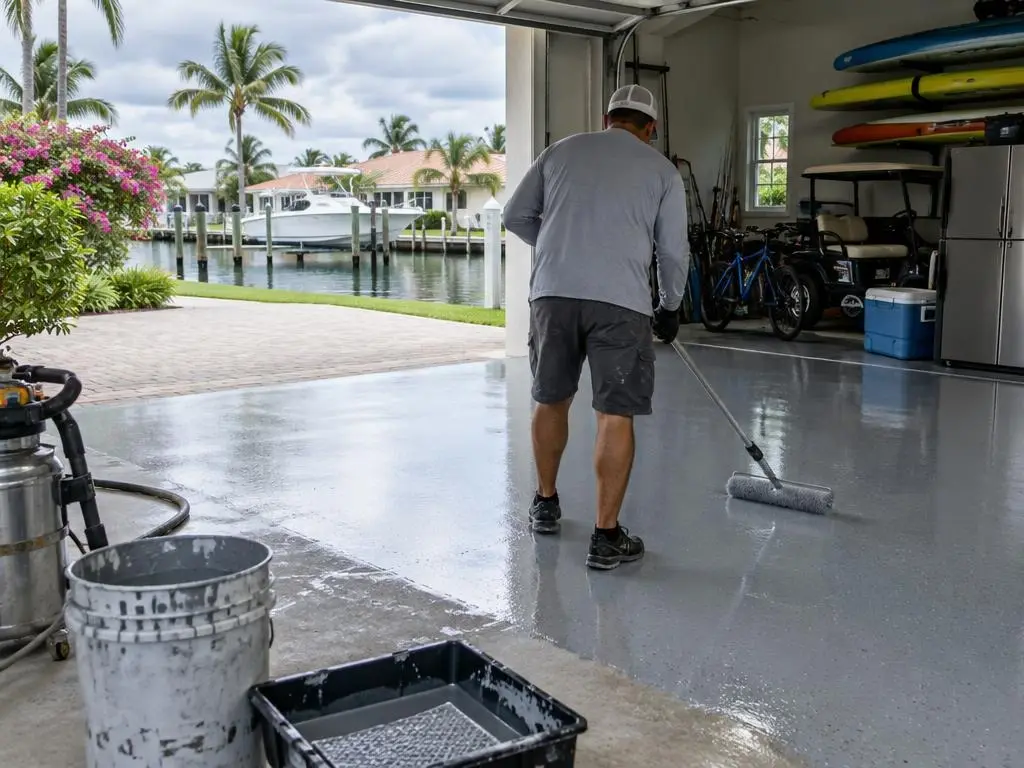
Typical Polyaspartic Coating Costs
| Floor and source | Published range |
|---|---|
| Per sq ft installed (HomeGuide) | $5 to $12 |
| One-car garage (HomeGuide) | $1,400 to $4,700 |
| Two-car garage (HomeGuide) | $2,000 to $6,900 |
| Three-car garage (HomeGuide) | $2,900 to $10,400 |
| 500 sq ft floor (HomeGuide) | $2,500 to $6,000 |
| Typical project (Bob Vila) | $1,440 to $3,240 |
| Per sq ft (Bob Vila) | $4 to $9 |
These national ranges come from Bob Vila's polyaspartic cost article and HomeGuide's polyaspartic floor coating guide. Prep work, repairs, flake and the number of coats all change the figure. After we see your floor, the written estimate we give you is the actual price.
Polyaspartic Install, Step by Step
1. Visit and moisture test
We measure, test the slab and talk through full versus hybrid systems.
2. Grind and repair
The floor is diamond ground and cracks and joints are filled.
3. Condition check
We read humidity, dew point and slab temperature right before mixing.
4. Base and broadcast
The base goes down in small, fast batches, with flake broadcast if chosen.
5. Clear coat and return
We apply the polyaspartic clear and give you walk-on and drive-on times.
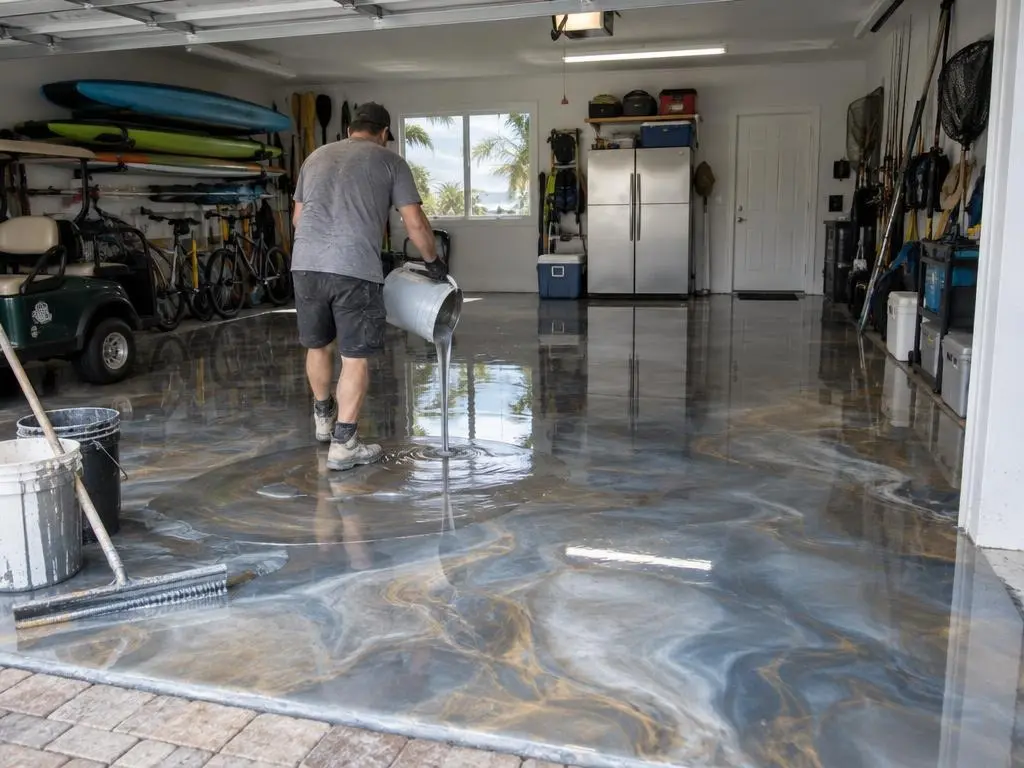
Why Choose Us for Polyaspartic Floor Systems
Mixed in small batches
Short working time means we mix only what can be spread and rolled cleanly.
Readings before every coat
We do not guess at humidity or dew point on a fast-curing product.
Side-by-side quotes
Ask and we will price polyaspartic and epoxy options together so you can compare.
Polyaspartic Floor Systems Questions
Is polyaspartic better than epoxy?
On sun resistance and cure time, yes. Epoxy builds thicker per coat and is often used as a base. For sunny garages and outdoor slabs here, we usually recommend polyaspartic on top at the least.
How soon is a polyaspartic floor ready to use?
Bob Vila puts walking at roughly 3 to 4 hours after the last coat, and vehicles at roughly 24 hours. HomeGuide puts full cure at one to two days. Heat and humidity can shift that a little.
Can I install polyaspartic myself?
We would steer you away from that. It sets quickly once mixed, so it must be spread and rolled fast and evenly, and it needs a ground, clean slab to bond to.
Does polyaspartic turn yellow?
Polyaspartic is aliphatic, which is why it holds color in sunlight. HomeGuide's chart puts it at excellent for UV, while epoxy sits at poor to fair.
Can polyaspartic go over my existing epoxy floor?
If the old floor is sound and well bonded, we can sand it and add a polyaspartic clear coat. If it is peeling or lifting, it has to come off first.
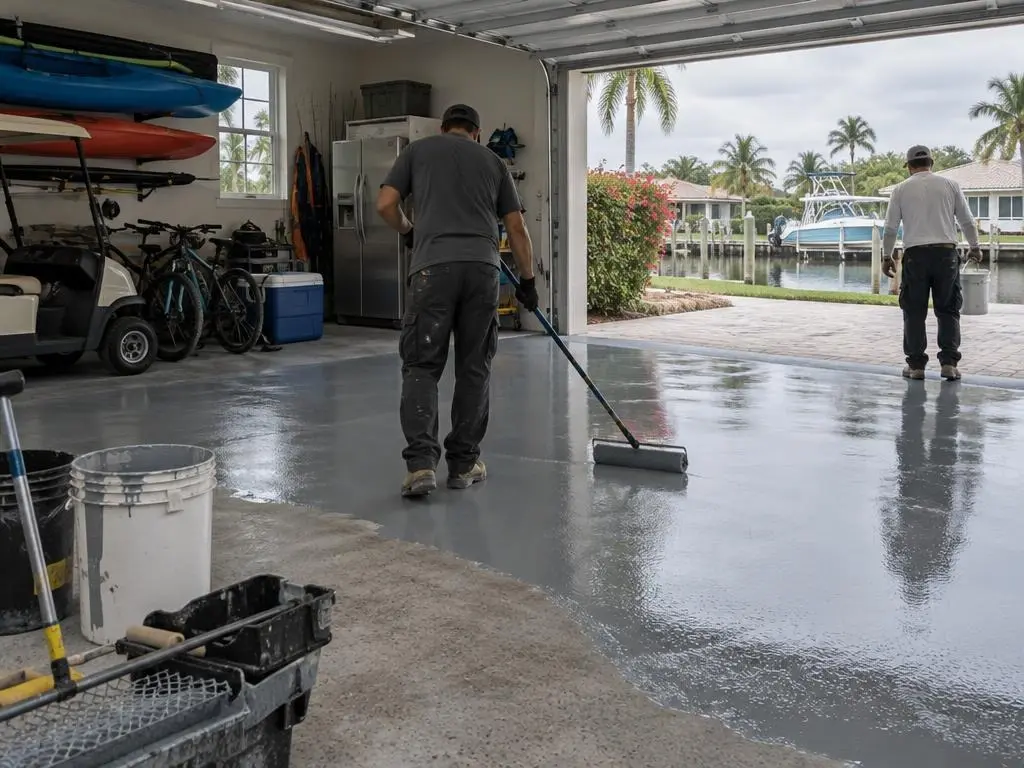
Polyaspartic Floor Systems Service Areas
- Epoxy Flooring in Fort Lauderdale, FL
- Epoxy Flooring in Victoria Park, FL
- Epoxy Flooring in Rio Vista, FL
- Epoxy Flooring in Harbor Beach, FL
- Epoxy Flooring in Coral Ridge, FL
- Epoxy Flooring in Flagler Village, FL
- Epoxy Flooring in Sailboat Bend, FL
- Epoxy Flooring in Colee Hammock, FL
- Epoxy Flooring in Las Olas Isles, FL
- Epoxy Flooring in Lauderdale-by-the-Sea, FL
- Epoxy Flooring in Hillsboro Beach, FL
- Epoxy Flooring in Sea Ranch Lakes, FL
- Epoxy Flooring in Lazy Lake, FL
- Epoxy Flooring in Wilton Manors, FL
- Epoxy Flooring in Oakland Park, FL
- Epoxy Flooring in Dania Beach, FL
- Epoxy Flooring in Broadview Park, FL
- Epoxy Flooring in Pembroke Park, FL
- Epoxy Flooring in West Park, FL
- Epoxy Flooring in Roosevelt Gardens, FL
- Epoxy Flooring in Washington Park, FL
- Epoxy Flooring in Franklin Park, FL
Get a Polyaspartic Floor Systems Estimate
Want your floor back fast? Ask about polyaspartic at (754) 240-3607.